
01 Pterigoideo lateral
Paso 1
Comprender el problema
Este módulo enseña la liberación del músculo pterigoideo lateral, un músculo profundo de la mandíbula que controla el movimiento anterior de la mandíbula y estabiliza la articulación temporomandibular. Cuando este músculo entra en espasmo, puede contribuir al dolor de mandíbula, chasquidos en la ATM, dolores de cabeza y tensión facial.
Paso 2
El problema clínico


El nervio mandibular pasa a través del vientre del músculo pterigoideo lateral, cerca del punto donde sale del cráneo.


Un paciente llega quejándose de dolor en la mandíbula, chasquidos en la articulación temporomandibular, dolores de cabeza cerca de las sienes o dificultad para abrir la boca por completo. A pesar del tratamiento de los músculos masetero y temporal, los síntomas persisten.
En muchos casos, la causa subyacente reside en una zona más profunda de la mandíbula, donde el músculo pterigoideo lateral ha entrado en espasmo y está comprimiendo directamente el nervio mandibular que pasa a través de su vientre.
Cuando se produce un espasmo, comprime este nervio y provoca el dolor extremo que se describe en los casos de disfunción de la articulación temporomandibular (ATM).
También inclina el cuerpo del hueso esfenoides hacia adelante.
Los extremos de este hueso se articulan con los huesos craneales que lo rodean en la sien. En su interior, es flexible como la hoja de un cuchillo. La silla turca puede inclinarse ligeramente hacia adelante y hacia atrás. Este pequeño movimiento es suficiente para deprimir el borde anterior del hueso esfenoides, dejándolo casi al ras del hueso palatino. Este movimiento, si nos centramos en la parte posterior de la silla turca, la empuja hacia la glándula pituitaria, de forma natural. Así es como el cuerpo extrae las hormonas pituitarias de la glándula. Esto explica por qué un bostezo se siente como se siente. El músculo pterigoideo lateral se contrae, inclina la parte posterior de la silla turca hacia adelante, hacia la glándula pituitaria, y luego se relaja. Cuando el pterigoideo lateral está en espasmo, se bloquea y la glándula pituitaria se comprime constantemente. Esto provoca sueños perturbadores o pesadillas. Esto provoca numerosos efectos secundarios en cadena relacionados con las hormonas, ya que la glándula pituitaria es la principal glándula hormonal del cuerpo, conectada neuralmente de forma directa al cerebro.
Aunque técnicamente compleja, esta liberación es clave para obtener importantes beneficios para la salud. La liberación del nervio mandibular y el alivio del dolor de la ATM son solo el comienzo.
Paso 3
¿Por qué sucede esto?
La causa principal del espasmo muscular (músculo pterigoideo lateral)

La causa principal del espasmo muscular (músculo pterigoideo lateral)
La mayoría de los dolores crónicos y las disfunciones en la mandíbula y la cabeza se originan por espasmos musculares más que por daños estructurales.
En esta modalidad, el músculo principal implicado es el pterigoideo lateral, que con frecuencia se ve afectado por:
• Apretar o rechinar los dientes (bruxismo)
• tensión mandibular relacionada con el estrés
• Masticar o usar chicle en exceso
• mala alineación o postura de la mandíbula
Cuando el músculo pterigoideo lateral se fatiga o se sobrecarga, puede entrar en un estado de contracción protectora, en el que las fibras musculares permanecen acortadas y se resisten a alargarse.
Con el tiempo, este espasmo crea varios problemas:
• acumulación de electrones estáticos
• Disminución de la circulación a través del tejido
• acumulación de desechos metabólicos
• Incapacidad para producir suficiente ATP
• Distribución deficiente de electrolitos
• compresión dentro de la articulación temporomandibular (ATM)
• movimiento restringido de la mandíbula
• Dolor referido en la cara, la sien y la cabeza.
El músculo pterigoideo lateral desempeña un papel fundamental en el control de la posición de la mandíbula y del disco de la articulación temporomandibular (ATM). Cuando sufre espasmos, puede desplazar el disco hacia adelante, lo que contribuye a la aparición de chasquidos, bloqueos y disfunción mandibular.
El cuerpo compensa esta situación activando los músculos masticatorios circundantes, lo que distribuye la tensión por toda la cara y la cabeza.
Para solucionar esto, identificamos el músculo pterigoideo lateral como el principal músculo en espasmo, determinamos la actividad que causó la fatiga y eliminamos ese estrés.
Los pacientes deben evitar comportamientos que agraven la afección, como apretar los dientes o masticar en exceso, durante aproximadamente seis semanas después del alta.
La liberación muscular restaura la capacidad del músculo para relajarse, permitiendo una mecánica mandibular normal y reduciendo la tensión y el dolor facial.
Paso 4
Anatomía
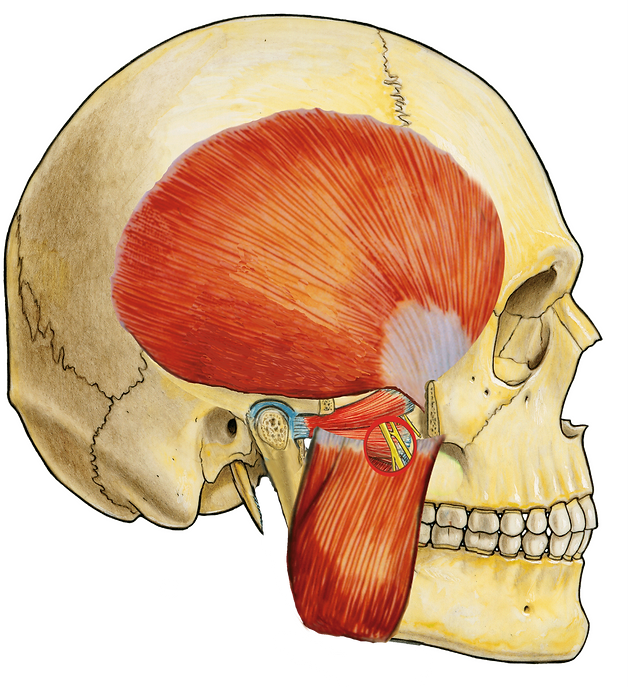
Esta modalidad se centra en el pterigoideo lateral, el músculo más influyente del cuerpo para la mecánica de la mandíbula, el dolor mandibular, la función pituitaria, la vista, el vibrato de los cantantes, las pesadillas o sueños inquietantes y la dinámica craneal en general. En muchos sentidos, es la piedra angular del cráneo.
Sus características anatómicas clave son:
• Origen: hueso esfenoides (ala mayor y lámina pterigoidea lateral)
• Inserción: cuello de la mandíbula y disco de la ATM
• Dirección de las fibras: horizontal
Función:
• protrae la mandíbula
• ayuda a abrir la mandíbula
• estabiliza y posiciona el disco de la ATM
La relación con el nervio mandibular
La rama mandibular del nervio trigémino (NC V3) sale del cráneo y pasa directamente por la región del pterigoideo lateral.
Cuando el pterigoideo lateral entra en espasmo:
• comprime el nervio mandibular dentro de sus fibras
• esto puede restringir mecánicamente la señalización a través del sistema trigeminal
• todos los músculos de la masticación pueden contraerse de forma refleja
• las ramas sensitivas de los dientes, la mandíbula y la cara pueden enviar señales de dolor
Esto explica por qué lo que comúnmente se diagnostica como dolor de ATM muchas veces no es un problema articular en absoluto, sino una compresión muscular profunda del nervio mandibular.
En muchos casos, el pterigoideo lateral es la causa principal y única de estos síntomas.
El papel del hueso esfenoides
El pterigoideo lateral se origina en el hueso esfenoides, un hueso central del cráneo que sostiene:
• la base del cráneo
• las estructuras del ojo
• la glándula pituitaria (dentro de la silla turca)
Aunque tradicionalmente se describe como fijo, la palpación clínica revela que el esfenoides puede presentar sutiles cambios de posición.
Cuando el pterigoideo lateral está en espasmo:
• tira del esfenoides hacia adelante a través de su punto de origen
• el cuerpo del esfenoides se inclina ligeramente hacia anterior
• este movimiento puede palparse internamente en la unión con el hueso palatino a lo largo de la línea media
Incluso un desplazamiento pequeño (aproximadamente 1 mm) puede tener efectos notables.
La relación entre la silla turca y la pituitaria
En el centro del esfenoides se encuentra la silla turca, que aloja la glándula pituitaria.
A medida que el esfenoides se inclina hacia adelante:
• la cara posterior ("respaldo") de la silla turca puede presionar contra la pituitaria
• esta interacción mecánica puede influir en la actividad pituitaria
En Releasology, esta relación se observa como una posible explicación de:
• fluctuaciones hormonales
• sueños vívidos o pesadillas
• cambios sistémicos después de la liberación
El bostezo puede representar un reflejo natural que altera temporalmente esta relación y que posiblemente ayuda a la regulación pituitaria.
Estas observaciones reflejan la relación integrada entre la tensión muscular, la estructura craneal y la función endocrina.
Paso 5
Músculos accesorios


El músculo pterigoideo lateral funciona como parte de un grupo coordinado de músculos de la mandíbula.
Músculo principal:
• Pterigoideo lateral
Músculos accesorios:
• Pterigoideo medial
• Masetero
• Temporal
Cuando el músculo pterigoideo lateral entra en espasmo, estos músculos a menudo compensan, creando:
• aumento de la tensión mandibular
• patrones de apretamiento
• movimiento desigual de la mandíbula
• Dolor facial y temporal generalizado
La liberación del músculo pterigoideo lateral suele reducir la tensión en todo el sistema masticatorio.
Paso 6 — Consecuencias neurológicas
El músculo pterigoideo lateral se sitúa en una intersección crucial entre el sistema del nervio trigémino y la base del cráneo.
La rama mandibular del nervio trigémino (V3) pasa directamente por la región del músculo pterigoideo lateral al salir del cráneo.
Cuando el músculo pterigoideo lateral entra en espasmo:
• Comprime el nervio mandibular dentro de sus fibras.
• Esto interrumpe tanto la señalización motora como la sensorial.
• Los músculos de la masticación pueden contraerse involuntariamente.
• Las ramificaciones sensoriales de los dientes y la mandíbula envían señales de dolor.
Esto crea una condición que a menudo se describe como:
• Dolor en la ATM
• Dolor de muelas sin causa dental
• dolor facial
• dolores de cabeza
• síntomas similares a la neuralgia del trigémino
En este modelo, lo que comúnmente se diagnostica como disfunción de la ATM a menudo no es un problema articular, sino una compresión muscular profunda del nervio mandibular.
El dolor de mandíbula se suele percibir en la superficie, pero su verdadera causa se encuentra más profundamente, en el músculo pterigoideo lateral.
Efectos craneales y esfenoidales
Debido a que el músculo pterigoideo lateral se origina en el hueso esfenoides, la contracción crónica puede influir en su posición.
En Releasology se observa que:
• El esfenoides puede inclinarse ligeramente hacia adelante cuando el músculo está en espasmo.
• Este movimiento se puede palpar a lo largo de la línea media cerca del hueso palatino.
• Incluso un movimiento sutil puede influir en las estructuras craneales circundantes.
A medida que el esfenoides se desplaza:
• El soporte de las estructuras orbitales puede verse alterado → visión borrosa
• La posición de la silla turca puede cambiar
• La pared posterior de la silla turca puede ejercer presión sobre la glándula pituitaria.
Esta relación puede contribuir a:
• dolores de cabeza
• visión borrosa
• sueños vívidos o pesadillas
• Cambios sistémicos vinculados a la función hipofisaria
Estas observaciones reflejan la relación integrada entre la tensión muscular, la estructura craneal y la función neurológica.

Paso 7
Demostración de la técnica
Observe la técnica utilizada para acceder y liberar el músculo pterigoideo lateral.
Puntos clave:
• Posicionamiento correcto de la mandíbula
• Acceso intraoral o externo seguro (se requieren guantes si es intraoral).
• Localización precisa de las fibras musculares profundas
• Compromiso Yang controlado
• Liberación lenta y paciente de Yin
Este músculo es profundo y muy sensible.
El objetivo es la precisión, no la fuerza.
Con guantes, deslice la punta del dedo índice a lo largo de la línea media del paladar, sobre el hueso palatino. Después del paladar se encuentra el paladar blando. Aquí se ubican el esfenoides y el músculo pterigoideo lateral. El reflejo nauseoso se localiza a los lados de este conducto, por lo que solo debe hacer contacto con el paladar durante todo el procedimiento. Al llegar al paladar blando, a cada lado, en la parte posterior, con presión hacia arriba, se puede palpar el pterigoideo lateral. Sujetar la cabeza con la otra mano mientras se palpa el músculo masetero puede ser útil para orientarse entre el pterigoideo lateral y los demás músculos masticatorios. El paciente no debe intentar abrir la boca, ya que esto lo hace el músculo que se está tratando de relajar. Al principio, este músculo se siente como un tendón tenso, y después de presionarlo hacia arriba, en la fase yang, y soltarlo lentamente, en la fase yin, comenzará a relajarse. Cuando esto sucede, los demás músculos masticatorios se relajan al instante, el paciente experimenta secreción nasal, puede lagrimear y oír y sentir el chasquido de los huesos del cráneo al alinearse mejor cuando se liberan el esfenoides y el nervio mandibular. Vea este video para más detalles.
Observa cómo el terapeuta localiza el músculo y permite que la liberación se produzca gradualmente.
Paso 8
Ejercicio de la hoja de trabajo

Completa la hoja de ejercicios para reforzar tu comprensión de esta modalidad.
Los estudiantes deben:
• Identificar el músculo pterigoideo lateral
• Etiqueta su origen en el hueso esfenoides
• Etiquete su inserción en el cuello de la mandíbula y el disco de la ATM.
• Identificar la vía del nervio mandibular (V3)
• Localizar el hueso esfenoides y la silla turca.
Ejercicio de dibujo (obligatorio)
Utilizando la herramienta de lápiz rojo de tu teléfono o tableta, dibuja el músculo pterigoideo lateral directamente sobre la hoja de trabajo.
Instrucciones:
• Dibuja el músculo desde su origen hasta su inserción.
• Asegúrese de que ambos extremos de su dibujo se conecten con los puntos de unión esqueléticos exactos.
• Delinear la forma general del vientre muscular
• Rellena el cuerpo del músculo para que refleje su verdadera orientación y dirección.
No es necesario que sea artístico, pero debe demostrar claramente que usted entiende:
• donde se inserta el músculo
• la dirección de sus fibras
• su relación con las estructuras circundantes
Ejercicio de aplicación
Después de terminar tu dibujo, traza cómo la disfunción en este músculo puede provocar:
• dolor de mandíbula
• dolores de cabeza
• dolor facial
• síntomas del nervio trigémino
• visión borrosa
Este ejercicio refuerza la conexión entre:
👉 Estructura → Función → Patrón de síntomas
Propósito de este ejercicio
Este paso es fundamental.
Ser capaz de dibujar el músculo correctamente confirma que realmente lo entiendes:
• su posición anatómica
• su función mecánica
• Cómo localizarlo durante el tratamiento
Este nivel de comprensión es necesario para realizar la técnica con precisión.
¡Tu hoja de trabajo ha sido enviada!
Paso 9
Tarea de práctica
Desarrollo de habilidades clínicas

Practica el lanzamiento con un compañero.
Pautas :
• Asegurar una higiene adecuada (guantes si es intraoral).
• Localiza cuidadosamente el músculo
• Aplicar una presión Yang lenta y controlada.
• permitir la liberación completa de Yin
Observar:
• cambios en el movimiento de la mandíbula
• reducción de la tensión o chasquido
• Comentarios de los clientes
Repite la técnica y perfecciona tu capacidad para localizar el músculo y realizarla con precisión.
Paso 10
Registro del tratamiento

Necesitarás:
• una superficie de tratamiento
• un tema de práctica
• guantes (si se utiliza la técnica intraoral)
• un trípode o una cámara estable
• buena iluminación
Coloca la cámara de manera que se vean claramente los siguientes elementos:
• la posición de tu mano
• Tu mecánica corporal
• dirección de la presión
• la mandíbula y la región facial
El vídeo debe mostrar toda la secuencia del tratamiento, desde el contacto inicial hasta la liberación completa.
Su grabación debe demostrar:
☑ Identificación precisa del músculo pterigoideo lateral
☑ Acceso seguro y controlado
☑ profundidad de presión correcta
☑ Mecánica corporal del practicante
☑ la fase de compromiso de Yang
☑ la fase de liberación del Yin
Se trata de una técnica que requiere precisión debido a la profundidad y la ubicación del músculo.
Su video de tratamiento ha sido
Carga realizada con éxito
Paso 11
Testimonio de un cliente

Pídele a tu cliente que describa:
• sus síntomas antes del tratamiento
• Nivel de dolor (0–10) antes
• nivel de dolor (0–10) después
• Cambios en el movimiento de la mandíbula, tensión facial o dolores de cabeza.
Los clientes suelen informar:
• reducción del dolor de mandíbula
• Disminución de la tensión facial
• Alivio de los dolores de cabeza
• Mayor movilidad de la mandíbula
Los testimonios pueden incluirse en la sección de resultados públicos.
Paso 12
Verificación de conocimientos y finalización del módulo
Verificación de conocimientos
Confirma que puedes:
• Identificar el músculo pterigoideo lateral
• Explicar su relación con el nervio mandibular (V3).
• Describir su efecto en la mecánica de la ATM.
• comprender su conexión con el hueso esfenoides
• reconocer los síntomas causados por su espasmo
Cuestionario de modalidad
Complete el siguiente cuestionario para confirmar su comprensión de la técnica de liberación del músculo pterigoideo lateral.
Para aprobar este módulo se requiere una puntuación del 80% o superior.
¿Cuál es el efecto principal de un espasmo en el músculo pterigoideo lateral?
A. Elevación y flexión de la mandíbula y articulación temporomandibular (ATM)
B. Extensión de la mandíbula, inclinación anterior de la silla turca del esfenoides y compresión del nervio mandibular.
C. Extensión del cuello
D. Elevación del hombro
¿A qué estructura afecta más directamente el músculo pterigoideo lateral?
A. Hueso frontal
B. Hueso esfenoides
C. Hueso hioides
D. Clavícula
¿Por qué la disfunción del músculo pterigoideo lateral puede contribuir a los dolores de cabeza?
A. Comprime los discos intervertebrales.
B. Altera la presión craneal y la mecánica de la ATM.
C. Debilita los músculos del cuello.
D. Reduce el oxígeno en la sangre.
Un signo clave de disfunción del músculo pterigoideo lateral es:
A. Incapacidad para encogerse de hombros.
B. Chasquido o desviación de la mandíbula al abrirla
C. Inestabilidad de la rodilla
D. Dolor de muñeca
En Releasology, la liberación de este músculo restaura principalmente:
A. Densidad ósea
B. Lubricación de las articulaciones
C. Seguimiento normal de la mandíbula y equilibrio de presión.
D. Longitud del ligamento
El resultado del cuestionario aparecerá aquí.