
26 Sciatic Nerve Decompression
This module teaches the release of the piriformis and surrounding deep hip muscles, which can compress the sciatic nerve and produce radiating leg pain.
Step 1
Understanding the Problem
Sciatica is commonly described as pain originating from the lower spine and traveling down the leg.In practice,
a far more consistent and direct cause is:
👉 compression of the sciatic nerve by the piriformis and deep hip rotators
The sciatic nerve passes directly beneath (and sometimes through) the piriformis.
When this muscle group enters spasm:
👉 the nerve becomes compressed
👉 pain radiates along its entire pathway
Step 2
The Clinical Problem

Sciatica is commonly described as pain originating from the lower spine and buttocks traveling down the leg.
There are 3 spinal nerve fibers, that exit the spinal cord to emerge from L3, 4 and 5. When the erector spinae, quadratus lumborum or even the latissimus dorsi muscles are in spasm, they can mildly compress these nerves, but not enough to cause sciatica as many health professionals imply. The truth is, the sciatic nerve does contain these fibers, but most of the sciatic nerve comes from its sacral nerve contributions that come from the anterior aspect of the sacral foramen. True sciatica is impingement of the entire sciatic nerve. This doesn't happen in the spine. Only between the greater sciatic notch and the piriformis can the entire nerve become trapped and squeezed. And, the piriformis, because of its path, is the only structure capable of doing this. Many would disagree, but getting confused about the difference between sciatica and piriformis syndrome is a smoke screen to push people in to a lumbar surgery or a lot of chiropractic - neither of which are capable of releasing these muscles. Only piriformis release techniques will resolve sciatica and they will resolve it all the way or the piriformis is still tight, so it needs more release work.
The sciatic nerve passes directly beneath (and sometimes through) the piriformis.
When this muscle group enters spasm:
👉 the nerve becomes compressed
👉 pain radiates along its entire pathway
👉 compression of the sciatic nerve is caused by the piriformis.
Step 3
Why This Happens

The piriformis and deep rotators stabilize the hip and control rotation.
These include:
-
piriformis
-
obturator internus
-
obturator externus
-
superior gemellus
-
inferior gemellus
-
quadratus femoris
When these muscles fatigue:
👉 they contract involuntarily
👉 they shorten and thicken
👉 they compress surrounding structures
The sciatic nerve runs directly through this region.
👉 When these muscles tighten, the nerve is compressed
This creates:
-
radiating pain
-
nerve irritation
-
loss of normal function
Step 4
Anatomy
 Deep Hip External Rotators |  Quadratus Femoris | 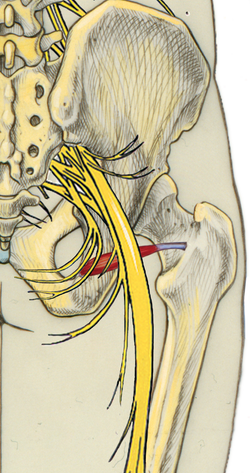 Gemellus Inferior |
|---|---|---|
 Obturator Externus | 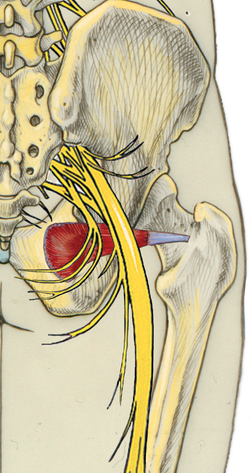 Obturator Internus |  Gemellus Superior |
To relieve sciatica, simply release the piriformis muscle.
The sciatic pattern is driven by a group of deep hip stabilizers that surround the posterior hip and form a functional compression zone around the sciatic nerve.
Piriformis
-
Origin: anterior sacrum
-
Insertion: greater trochanter
-
Location: deep gluteal, running horizontally
👉 The sciatic nerve passes directly beneath (and sometimes through) this muscle.
When in spasm:
👉 it compresses the nerve at its most vulnerable point
Obturator Internus
-
Origin: internal surface of obturator membrane
-
Insertion: greater trochanter (via tendon exiting pelvis)
-
Location: deep, emerging from pelvis
Key relationships:
-
the obturator nerve passes through this region
-
connected via fascial raphé to the levator ani
👉 When in spasm:
-
can compress the obturator nerve
-
can laterally pull on the pelvic floor
Obturator Externus
-
Origin: external obturator membrane
-
Insertion: trochanteric fossa of femur
-
Location: deep anterior/posterior hip junction
👉 When in spasm:
-
contributes to deep hip compression
-
may affect both:
-
sciatic nerve indirectly
-
obturator nerve directly
-
Gemellus Superior & Inferior
-
Origin: ischial spine (superior), ischial tuberosity (inferior)
-
Insertion: join obturator internus tendon
👉 Act as stabilizers of the obturator system
👉 Reinforce compression when the system is tight
Quadratus Femoris
-
Origin: ischial tuberosity
-
Insertion: intertrochanteric crest
👉 Thick, powerful stabilizer directly beneath the sciatic pathway
When in spasm:
👉 creates a firm inferior compression shelf under the nerve
System Insight
Together, these muscles form:
👉 a layered rotational and stabilization system
👉 surrounding both:
-
the sciatic nerve
-
the obturator nerve
-
and influencing the pelvic floor
Key Integration
👉 Piriformis = primary compression point
👉 Obturators = dual nerve influence (sciatic + obturator)
👉 Obturator internus = pelvic floor interaction via levator ani
This is not just a hip issue.
👉 It is a hip–nerve–pelvic system
Step 5
Palpation & Tissue Assessment

Position:
-
client prone or side-lying
Your goal is not just to “find a muscle.”
👉 Your goal is to locate compression zones along the nerve path
Primary Landmark — Piriformis
-
midpoint between sacrum and greater trochanter
Palpate:
-
deep, slow pressure
palpate for:
-
dense band
-
tenderness
-
reproduction of sciatic symptoms
👉 This is the primary access point
Inferior Layer — Deep Rotators
Move inferior and lateral:
Quadratus Femoris - most inferior of the group
-
below gemelllus inferior
-
thick, horizontal
👉 feels like a dense shelf
Obturator Internus & Gemelli
-
deeper and slightly medial
Palpation:
-
more subtle
-
requires patience
In spasm:
👉 tissue feels deep, resistant, less defined
Anterior/Deep Influence (Conceptual Awareness)
While not always directly accessible:
👉 the obturator muscles influence deeper structures
Watch for:
-
pelvic tension
-
deep hip restriction
-
unusual resistance patterns
These may reflect:
👉 obturator involvement
👉 pelvic floor tension via levator ani
Tissue Quality
In spasm:
-
dense
-
resistant
-
non-yielding
-
may reproduce nerve symptoms
Healthy tissue:
-
compressible
-
elastic
-
responsive
Clinical Confirmation
👉 pressure reproduces sciatic pathway sensation
This is key.
Not just local pain:
👉 radiation confirms nerve involvement
Key Insight (Refined and Powerful)
You are not just treating a muscle.
👉 You are identifying where the nerve is being compressed
And often:
👉 multiple muscles contribute to that compression

Step 8
Worksheet Exercise

First, dowload the pdf worksheet, below. Using a red pen or pencil tool, draw the hip rotators:
Draw:
-
piriformis
-
quadratus femoris
-
obturator internus
-
gemellus superior
-
gemellus inferior
Also draw:
-
path of sciatic nerve
Fill at least 80% of the anatomical space the muscle occupies.
Then add:
• Origin
• Insertion
• Movement
• Innervation
Save your completed worksheet and upload it by clicking the white upload button, below
Step 9
Practice Assignment
Clinical Skill Development

Position client:
-
prone
Technique:
-
locate piriformis
-
apply deep, steady pressure
-
maintain contact through release
Then explore:
👉 inferior and lateral regions (other rotators)
Focus on:
-
precision
-
depth through structure (not force)
-
sustained engagement
Step 10
Treatment Recording

Record your full treatment session using a tripod.
Setup Requirements
-
Use a tripod to hold your phone (no assistant)
-
Ensure:
-
your hands are clearly visible
-
the client’s hip landmarks are visible
-
lighting is sufficient to see depth and positioning
-
Your Video Must Show:
-
identification of:
-
sacrum
-
greater trochanter
-
-
accurate location of the piriformis
-
progression into:
-
quadratus femoris
-
surrounding deep hip rotators
-
Technique Requirements
Your recording must demonstrate:
-
correct hand placement
-
controlled, steady pressure
-
proper body mechanics
-
Yang → Yin transition
-
sustained engagement (not poking or bouncing)
Important
👉 One hand must clearly show contact and pressure
👉 Your body positioning must show control and grounding
Upload Instructions
After recording:
-
Review your video
-
Ensure:
-
your technique is clearly visible
-
both hands are in frame
-
the treatment sequence is complete
-
-
Upload your video to this section:
👉 Use the Upload Button below
👉 If the correct file is uploaded
👉 Click the black submit button, below that
Step 11
Client Testimonial

Record your full treatment session using a tripod.
Setup Requirements
-
Use a tripod to hold your phone (no assistant)
-
Ensure:
-
your hands are clearly visible
-
the client’s hip landmarks are visible
-
lighting is sufficient to see depth and positioning
-
Your Video Must Show:
-
identification of:
-
sacrum
-
greater trochanter
-
-
accurate location of the piriformis
-
progression into:
-
quadratus femoris
-
-
surrounding deep rotators
Technique Requirements
Your recording must demonstrate:
-
correct hand placement
-
controlled, steady pressure
-
proper body mechanics
-
Yang → Yin transition
-
sustained engagement (not poking or bouncing)
Important
👉 One hand must clearly show contact and pressure
👉 Your body positioning must show control and grounding
Upload Instructions
After recording:
-
Review your video
-
Ensure:
-
your technique is clearly visible
-
both hands are in frame
-
the treatment sequence is complete
-
-
Upload your video to this section:
👉 Use the Upload Button below
👉 Select your recorded file
👉 Confirm submission
Step 12
Knowledge Check & Modality Completion
Complete the quiz for this module.
Passing Requirement
👉 Score 80% or higher
You Must Understand:
-
piriformis is the cause of sciatica
-
role of deep rotators
-
sciatic nerve pathway
-
obturator nerve involvement
-
pelvic floor connection via obturator internus
-
correct palpation and technique
Final Completion Checklist
Before moving on, confirm you have:
✔ Completed the worksheet
✔ Practiced the technique
✔ Recorded your treatment video
✔ Uploaded your treatment video
✔ Recorded client testimonial
✔ Uploaded your testimonial video
✔ Passed the quiz (≥ 80%)
Completion
Once all steps are complete:
👉 this modality is finished
👉 you are ready to move to the next section
1. Which muscle is the primary cause of sciatic compression?
A. Gluteus maximus
B. Piriformis
C. Hamstrings
D. Quadriceps
2. What happens when piriformis is in spasm?
A. Improved mobility
B. Compression of the sciatic nerve causing leg pain
C. Increased strength
D. Better posture
3. What is a key symptom?
A. Arm pain
B. Radiating pain down the leg (sciatica)
C. Wrist stiffness
D. Neck pain
4. What is the Releasology solution?
A. Stretching
B. Direct release of piriformis spasm
C. Strengthening
D. Heat
5. Release restores:A. Bone density
B. Balanced abdominal pressure, motility and mobility
C. Muscle growth
D. Ligament elasticity